Friday, November 6, 2015

Slopes of Mount Kugami - Ryokan


Slopes
 of Mount Kugami –
 in the mountain’s shade
 a hut beneath the trees – 
how many years
 it’s been my home? 
The time comes
 to take leave of it –
 my .though/ts wilt
 like summer grasses,
 I wander back and forth
 like the evening star –
 till that hut of mine
 is hidden from sight, 
till that grove of trees 
can no longer be seen,
 at each bend
 of the long road, 
at every turning,
 I turn to look back
 in the direction of that mountain 

 translated by Burton Watson: from the book Ryokan: Zen Monk-Poet of Japan.

Wednesday, November 4, 2015

Enlightenment is like the moon - Dogen


Enlightenment is like the moon reflected on the water.

The moon does not get wet, nor is the water broken.

Although its light is wide and great,

The moon is reflected even in a puddle an inch wide.

The whole moon and the entire sky

Are reflected in one dewdrop on the grass.


Monday, November 2, 2015

Two Sciences of Mind

 by

Left: MRI of a head-section showing the cerebral cortex, the corpus callosum, the pons and medulla, and the cerebellum. Image by Mehau Kulyk / Science Photo Library.


Barry Boyce reports on the dialogue between cutting-edge science and Buddhism’s 2500-year study of the mind.

In 1979, two cognitive scientists, Francisco Varela and Eleanor Rosch, and a computer scientist named Newcomb Greenleaf — all freshly minted Buddhists — organized what was to be a groundbreaking conference at The Naropa Institute in Boulder, Colorado. Recently established by Tibetan meditation master Chögyam Trungpa Rinpoche, the institute was designed to be a place where meditation traditions and western scholarship would meet on common ground.

Empty your cup


Nan-in, a Japanese master during the Meiji era (1868-1912), received a university professor who came to inquire about Zen. Nan-in served tea.

He poured his visitor’s cup full, and then kept on pouring. The professor watched the overflow until he no longer could restrain himself. “It is overfull.

No more will go in!” “Like this cup,” Nan-in said, “you are full of your own opinions and speculations. How can I show you Zen unless you first empty your cup?”

Sunday, November 1, 2015

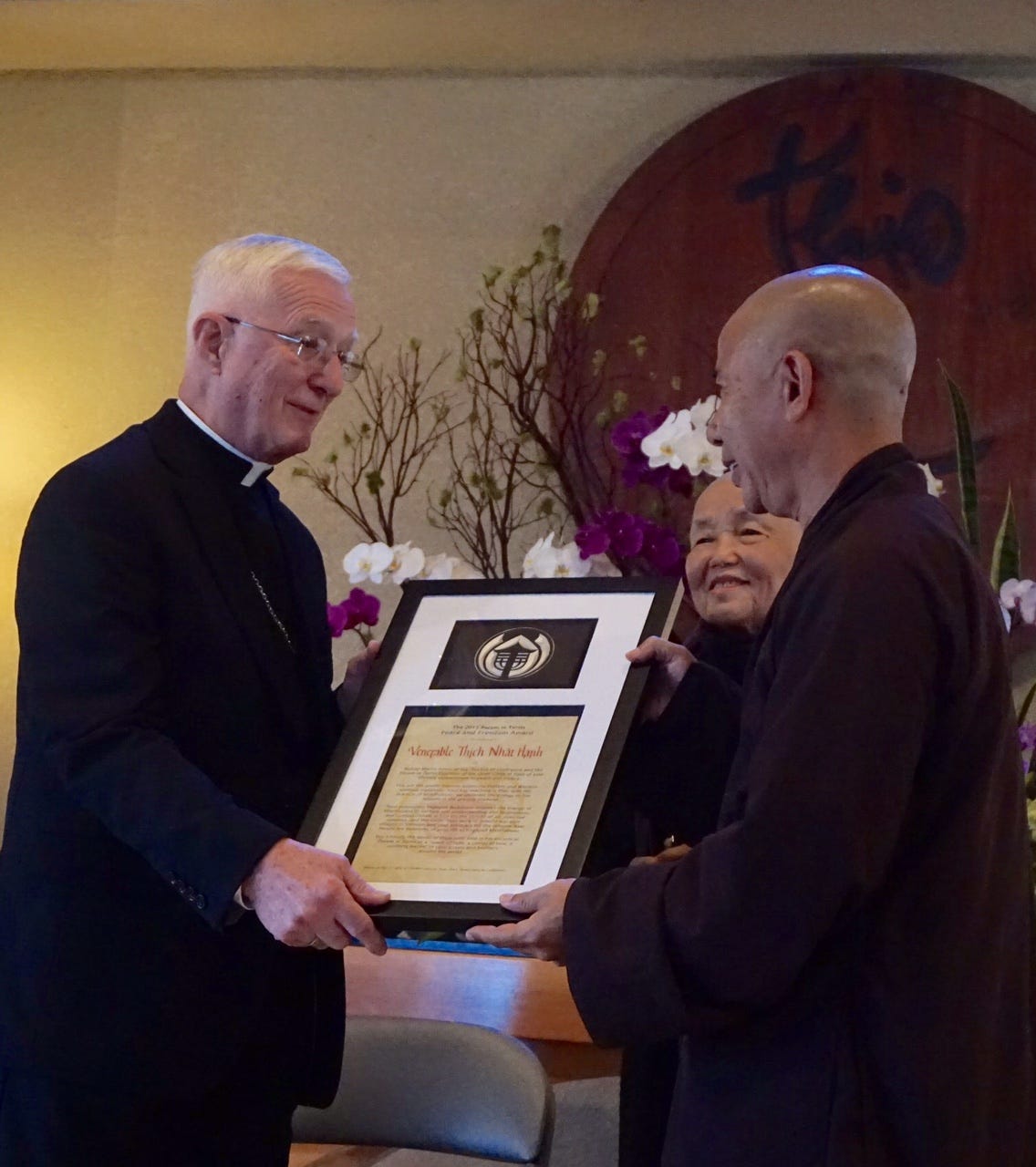
Thich Nhat Hanh Receives the Pacem in Terris Peace and Freedom Award

Zen Master Thich Nhat Hanh, renowned for bridging Eastern and Western spirituality, is the 2015 Pacem in Terris Peace and Freedom Award recipient.
Bishop Martin Amos traveled to Deer Park Monastery in southern California to present the award on Saturday, October 31, 2015 to the 89-year old Zen master. Sister Chan Khong and Brother Phap Dang accepted the award on behalf of Thich Nhat Hanh, who continues to recover in San Francisco, in the presence of 120 monastics and 500 retreat participants.


Thich Nhat Hanh is receiving the Pacem in Terris award on the 50th anniversary year of Martin Luther King Jr.’s selection for the same award. The two religious leaders shared a peace and nonviolence bond that influenced the political climate in the late 1960s.

Disappearance- Thich Nhat Hanh

The leaf tips bend
under the weight of dew.
Fruits are ripening
in Earth’s early morning.
Daffodils light up in the sun.
The curtain of cloud at the gateway
of the garden path begins to shift:
have pity for childhood,
the way of illusion.
Late at night,
the candle gutters.
In some distant desert,
a flower opens.
And somewhere else,
a cold aster
that never knew a cassava patch
or gardens of areca palms,
never knew the joy of life,
at that instant disappears-
man’s eternal yearning.

Working Very Hard


 A martial arts student went to his teacher and said earnestly, “I am devoted to studying your martial system. How long will it take me to master it.” 

 The teacher’s reply was casual, “Ten years.”

 Impatiently, the student answered, “But I want to master it faster than that. I will work very hard. I will practice everyday, ten or more hours a day if I have to. How long will it take then?” 

The teacher thought for a moment, “20 years.”